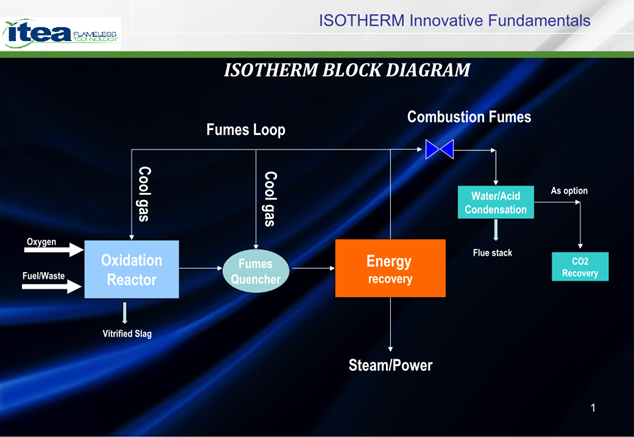
The technology was developed in a large sized demonstration plant (5 MWt) set up in Sofinter/Ansaldo’s research centre at Gioia del Colle; today the plant is used for campaign trials on specific materials that must be treated. The process is very simple (see the flow chart):
- The material to be treated (gas, liquid or solid) is introduced into the reactor together with the technical oxygen (88-94%) (solid material is introduced in an aqueous suspension). The plant also accepts multiple feedings of different materials;
- In the reactor, under pressure and at a uniform temperature between 1300 and 1500 °C, combustion occurs in a completely different way from traditional combustion: there is no formation of a flame (“flameless”) and the oxidation of the material takes place homogeneously throughout the whole reactor chamber in an orderly, foreseeable and controllable manner, with the exclusive production of CO2 and water vapour.
- Reactor temperature is controlled by varying the amount of recycled cold fumes; the ashes melt in the reactor and fall from the bottom of the reactor in a stream of water that causes its instant solidification into inert pearls of vitreous structure;
- The fumes leaving the reactor at 1300 – 1500 °C consist essentially of water steam and CO2, and are cooled to 700-800 °C by being mixed with cold recycled fumes; they then enter the boiler that cools them further to about 250 °C. The heat released by the fumes is used to produce steam or for the production of electricity.
- On leaving the boiler the fumes are partially recycled to the plant; a portion go to the fumes treatment section that, given the fumes’ particular purity, is very simple, consisting of a column for the breakdown of acids and a bag filter; at the filter outlet the fumes consist essentially of clean CO2, ready for use.
- In the case where the treated material contains a significant amount of heavy metals (toxic waste) the fumes treatment section is also provided with a column for heavy metal, which separates out from the fumes any heavy metal fraction that was not incorporated into the solidified slag leaving the reactor (for ex. Mercury).
The technology has been patented and is protected by 10 International patents.
The plant requires the supply of technical oxygen, 88-94% purity, (cryogenic oxygen is not necessary), oxygen that, for small-sized applications, is produced by the plant, extracting it from the air with commercially available units (VSA); larger sized applications (coal applications) require cryogenic oxygen plants.
In small sized applications (toxic waste treatment, municipal waste treatment, etc.) it can be convenient to install, downstream from the fumes; in large sized applications (coal applications) it can be convenient to compress the CO2 for EOR (enhanced oil recovery) and CCS (carbon capture & sequestration) use.